


Virtual Assistant For Entrepreneurs: 4 Tips to Beat Burnout
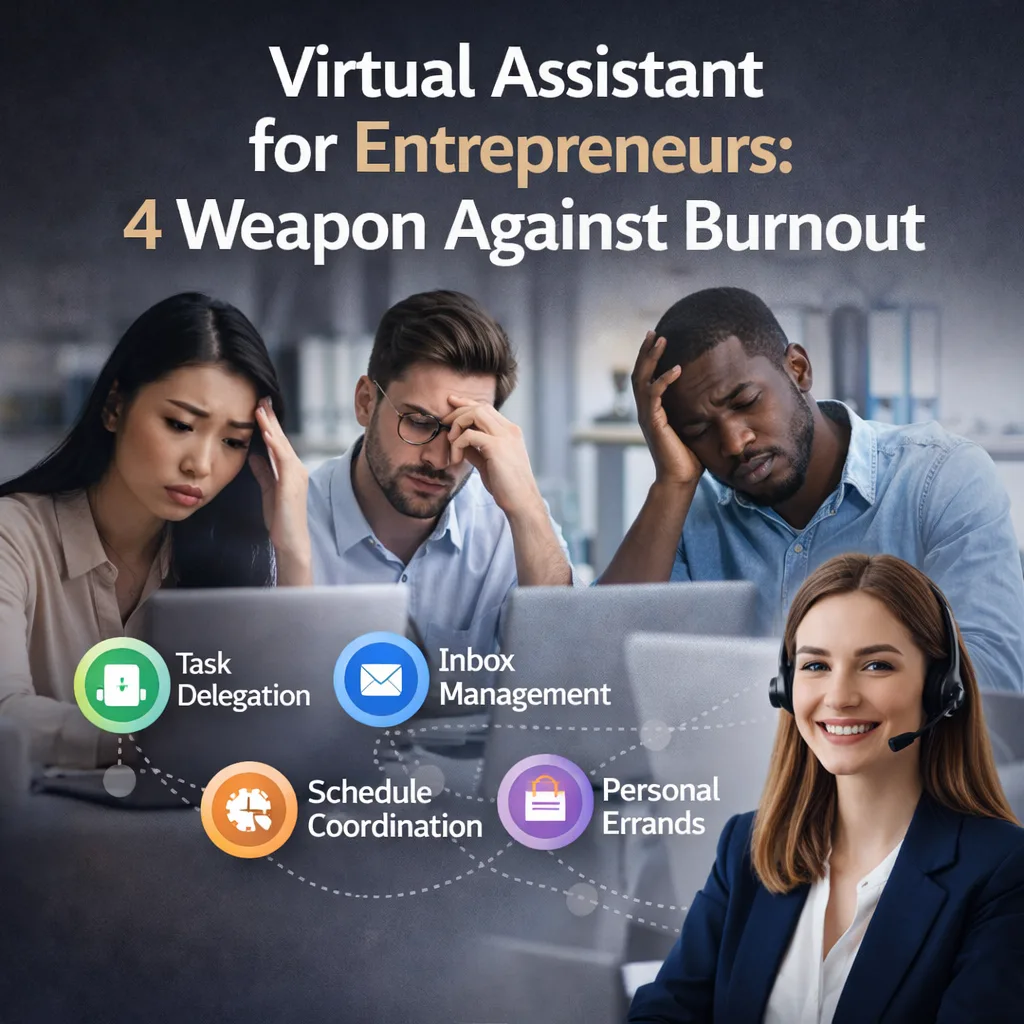
Virtual Assistant for Entrepreneurs: 4 Weapon Against Burnout
Let’s call it like it is: entrepreneurship is glamorized on social media and brutal in real life.
You’re juggling:
- Sales and marketing
- Client delivery
- Operations
- Finances
- Hiring
- And still trying to be a functioning human at home
It’s not that you’re “bad at time management.”
It’s that you’re trying to play every role in the company at once. That’s not lack of discipline; that’s a structural problem.
Burnout doesn’t usually arrive with fireworks. It creeps in slowly:
- You snap at people you care about.
- You start resenting your inbox.
- Creative ideas feel heavy instead of exciting.
- You’re constantly “on,” but never feel caught up.
A virtual assistant for entrepreneurs isn’t just about outsourcing tasks. Done well, it’s a strategic move to redesign how your energy, time, and attention are spent.
What a Virtual Assistant for Entrepreneurs Actually Does (Beyond “Admin Stuff”)
Some people still imagine a VA as someone who just books flights and formats documents. That’s a tiny sliver of what’s possible now.
A good virtual assistant is a force multiplier. They give structure to your chaos.
1. Operational Backbone
These are the unsexy but absolutely essential pieces they can own:
- Inbox triage and email responses
- Calendar management and meeting prep
- Follow-ups with leads, clients, and vendors
- Document organization and file management
- Travel bookings, invoices, reminders
This alone can save you several hours a day. Not exaggerating—just think about how much time you lose in your inbox.
- Revenue-Related Support
Many entrepreneurs don’t realize a virtual assistant for entrepreneurs can sit closer to the money than they think:
- Preparing proposals and quotes
- Sending contracts and digital agreements
- Following up on unpaid invoices
- Setting up simple funnels or landing pages (if they’re skilled there)
- Updating product listings or sales pages
You’re still in charge of strategy; they handle the repetition that makes revenue consistent.
- Customer & Client Experience
Your VA can be the “first face” or “first voice” of your brand:
- Responding to inquiries
- Drafting answers to FAQs
- Scheduling calls
- Sending onboarding emails
- Gathering testimonials and feedback
That means your customers feel held… even when you’re deep in focus work.
- Personal Life Support (Yes, Really)
This one’s underrated.
Many entrepreneurs use their VA for things like:
- Booking dentist and doctor appointments
- Ordering gifts
- Researching purchases
- Managing subscriptions
Is that “allowed”? Absolutely. You’re not just running a business—you’re running a life. Freeing mental space anywhere impacts your productivity everywhere.
How a Virtual Assistant for Entrepreneurs Actually Enhances Productivity
Let’s get specific. “More productive” sounds nice, but what does it look like on a Tuesday afternoon?
The Time Leverage Effect
Imagine your tasks in three buckets:
- $10 tasks – Data entry, scheduling, admin
- $100 tasks – Coaching a client, closing a sale, negotiating
- $1,000 tasks – Designing a new offer, entering a new market, key partnerships
When you don’t have support, you’re forced to spend precious hours on $10 tasks, which means you have less energy for the $1,000 work only you can do.
A virtual assistant for entrepreneurs is there to crush those $10 tasks so your calendar is full of $100 and $1,000 work. That’s how revenue and impact grow without you stretching thinner.
Reducing Context Switching
Ever started writing a proposal, then checked an email “for a second,” answered a Slack message, changed a calendar invite, and then… forgot what you were writing?
That’s context switching. And it’s expensive.
Your VA acts as a buffer against it by:
- Guarding your calendar
- Grouping your meetings
- Preparing what you need before calls
- Handling micro-requests from clients or team members
Instead of getting interrupted 40 times a day, you get one Slack summary from your VA and handle decisions in batches. Your brain finally gets to stay in one lane at a time.
Turning Chaos Into Systems
Entrepreneurs tend to run on instinct. You know how to get the job done, but it often lives in your head.
A skilled VA starts turning that “head knowledge” into checklists, templates, and workflows:
- A repeatable client onboarding flow
- A podcast guest process
- A weekly reporting rhythm
- A standard way to handle refunds or reschedules
Suddenly, your business is less “you doing everything” and more “a machine others can help operate.”
How a VA Helps Reduce Burnout (Not Just Move It Around)
Here’s something important: hiring help can either reduce burnout… or make it worse if you do it poorly.
Done right, a virtual assistant for entrepreneurs helps in three major ways.
Emotional Load Sharing
Burnout isn’t just about tasks; it’s about carrying everything alone.
Your VA becomes the person who:
- Reminds you what actually matters today
- Monitors deadlines
- Flags issues before they become problems
- Helps you feel less alone in the grind
Sometimes, just knowing “someone else is watching the moving parts” makes everything feel lighter.
Better Boundaries and Time Off
You might say you care about rest, but if you’re answering emails at midnight… your nervous system isn’t buying it.
Your VA can help enforce actual boundaries:
- Setting expectations with clients about response times
- Drafting out-of-office messages
- Managing communications during your time away
- Clearing non-urgent items before they reach you
You’re still responsible for honoring your boundaries—but now you’re not trying to defend them alone.
Creating a Sustainable Pace
Burnout usually happens when your output is consistently higher than your input (rest, support, recovery).
When a virtual assistant for entrepreneurs is integrated well, you get:
- More white space on your calendar
- Fewer “emergency” situations
- More time on high-impact work that actually energizes you
You stop operating in survival mode and start being intentional again.
A Simple Delegation Framework for Entrepreneurs
“Okay, but what do I actually give them?”
Good question.
Here’s a simple 4-step framework you can use every week.
Step 1: List Out Everything You Did Yesterday
Seriously. Yesterday is easier to remember than “in general.” Write it down:
- Responded to 36 emails
- Edited a Canva graphic
- Sent three invoices
- Rescheduled a meeting
- Wrote a proposal
- Checked tracking numbers for shipments
No filtering. Just brain dump.
Step 2: Tag Each Task with D, A, or K
- D = Delegate – Could a capable VA do this with the right instructions?
- A = Automate – Could a tool handle this? (Calendly, Zapier, etc.)
- K = Keep – Only you can do this right now.
Your goal over time? Increase the percentage of “K” tasks you do… and aggressively move “D” and “A” off your plate.
Step 3: Start With “Low-Risk, High-Frequency” Tasks
Perfect for a virtual assistant for entrepreneurs:
- Scheduling and rescheduling
- Simple customer service replies
- Document formatting
- Social media scheduling (not strategy, just posting)
- Reminders and follow-ups
These are hard to mess up, easy to document, and instantly time-saving.
Step 4: Then Move Into “Revenue-Adjacent” Tasks
Once trust is built, your VA can help with:
- Lead tracking
- Following up with warm leads
- Preparing sales materials
- Updating CRM records
You’re still in control of the actual sales calls, but they keep the pipeline warm and moving.
Real-Life Style Scenarios: How Entrepreneurs Use VAs to Stay Sane
Let’s ground this in some realistic examples.
Scenario 1: The Solo Coach
Maria runs a 1:1 and group coaching business. Before hiring a VA, her week looked like:
- 15–20 coaching calls
- 5–10 hours in her inbox
- Late-night admin catchup
- Constant rescheduling headaches
After hiring a virtual assistant for entrepreneurs:
Her VA now:
- Handles all scheduling and rescheduling
- Onboards new clients
- Sends pre-call questionnaires
- Collects testimonials
- Preps her call notes and summary templates
Maria now spends the majority of her time coaching and creating, not chasing links and appointments. Her revenue went up—not because she “hustled harder,” but because her time is finally aligned with her zone of genius.
Scenario 2: The Ecom Founder
Jay runs an ecommerce brand. His overwhelm came from:
- Customer support
- Tracking orders
- Updating product descriptions
- Coordinating with suppliers
His VA stepped in to:
- Answer repetitive support questions
- Send order updates
- Maintain a dashboard of low-stock items
- Coordinate with suppliers about shipping timelines
Jay finally had headspace to focus on marketing campaigns and product development. Burnout started to fade because he wasn’t drowning in operational noise.
How to Find the Right Virtual Assistant for Entrepreneurs (Not Just “Any VA”)
Not every VA is a fit for entrepreneurial chaos. You want someone who can handle ambiguity without shutting down.
Look for:
- Entrepreneur-facing experience – Have they supported founders or CEOs before?
- Tool familiarity – Calendly, Google Workspace, Notion, CRMs, project tools like ClickUp or Asana.
- Asking smart questions – Do they ask about your goals, not just your tasks?
- Communication style – Concise, proactive, not needy.
- Ownership mindset – They don’t wait to be micromanaged; they propose improvements.
Red flags?
- Vague about their past roles
- Slow response times from the beginning
- Discomfort with learning new tools
- Easily flustered by shifting priorities
You’re not just hiring hands—you’re hiring judgment.
Onboarding Your Virtual Assistant Without Creating More Work for Yourself
A big fear entrepreneurs have is:
“Isn’t onboarding going to take more time than just doing it myself?”
Short-term? It does take a bit of effort.
Medium- and long-term? It’s one of the highest ROI moves you’ll ever make.
Here’s a simple way to keep it sane.
Week 1–2: Observe and Document
- Record Loom videos of yourself doing recurring tasks
- Talk through your decisions out loud
- Let your VA watch and ask questions
Don’t write a 40-page SOP manual. Just share real workflows.
Week 3–4: Delegate and Shadow
- Let them try tasks while you review
- Start small: scheduling, simple replies, reminders
- Give feedback fast and kindly
Week 5–8: Hand Off Ownership
- Move them into managing entire areas (calendar, inbox, client onboarding)
- Ask them to propose improvements
- Have weekly check-in calls to review priorities
Over time, your VA becomes the one building the SOPs, not you.
Common Mistakes Entrepreneurs Make With VAs (So You Can Avoid Them)
Let’s talk about the traps.
Mistake 1: Hiring Too Late
Most founders wait until they’re already heavily burned out. At that point, you’re tired and you have to train someone. If you have a sense you’ll need help “soon,” that’s usually the right time.
Mistake 2: Expecting Mind Reading
A virtual assistant for entrepreneurs is talented, not telepathic.
You still need to:
- Communicate priorities
- Share context
- Explain what “good” looks like
The more clarity you give, the more magic they can work.
Mistake 3: Hoarding Tasks Out of Habit
You’ll feel the temptation to say, “It’s quicker if I do it myself.” And sometimes it is. The problem is, that logic keeps you stuck forever.
Use a rule of thumb:
“If I will need this done 10+ times, I should teach it once.”
Mistake 4: Treating Them as a Tool, Not a Partner
The entrepreneurs who gain the most from a VA treat them like a trusted teammate. They share the vision, the why, and the bigger picture.
When your assistant feels invested, they go beyond tasks and help you build a better business.
Frequently asked questions (FAQ)
1. What does a virtual assistant for entrepreneurs actually do day-to-day?
A virtual assistant for entrepreneurs typically handles email management, scheduling, client follow-ups, document organization, simple marketing tasks, basic research, and other recurring operations that keep the business moving while freeing up the founder’s time.
2. How does a virtual assistant help reduce burnout for entrepreneurs?
They take over repetitive, draining tasks so you can focus on strategic work and rest. By managing your calendar, communications, and routine workflows, a virtual assistant creates more white space for thinking, creativity, and actual downtime—key ingredients for preventing burnout.
3. When is the right time to hire a virtual assistant as an entrepreneur?
You’re usually ready when you notice you’re spending more time on admin than on growth, are dropping balls, or feel constantly behind. If you keep thinking, “I’ll hire help when things calm down,” that’s often the sign you needed a VA yesterday.
4. Is a virtual assistant for entrepreneurs only helpful for bigger businesses?
Not at all. Solo founders and small teams arguably benefit the most. Even a few hours a week of support can dramatically increase your productivity, reduce stress, and help you feel less alone in the business.
5. What tasks should I delegate first to a virtual assistant?
Start with low-risk, high-frequency tasks: scheduling, simple email replies, client reminders, file organisation, and basic reporting. Once trust is built, you can move into revenue-adjacent tasks like lead follow-ups, content scheduling, or light project coordination.
6. How do I manage a remote assistant if I’m already busy?
Use simple tools and routines: one project management board, a shared priority list, weekly check-in calls, and short screen recordings to explain tasks. A good virtual assistant for entrepreneurs will help you simplify—not complicate—your workflow.
7. Can a virtual assistant really improve my productivity, not just “save time”?
Yes. By reducing context switching, implementing systems, and acting as a buffer between you and constant requests, a VA improves the quality of your working time. It’s not just about hours saved; it’s about better focus and higher-value output.
Recent Posts
- What Is CRM Automation? Save 10+ Hours a Week
- Virtual Assistant for Shopify Store End-to-End Operations at $6/hr
- Virtual Assistant for Shopify Store End-to-End Operations at $6/hr
- Virtual Assistant For Entrepreneurs: 4 Tips to Beat Burnout
- The Ultimate Guide to Virtual Assistant Call Answering Services in 2026
Categories
Populer Posts

What Is CRM Automation? Save 10+ Hours a..
By Sam April 13, 2026
Virtual Assistant for Shopify Store End-to-End Operations at..
By Sam April 2, 2026

Virtual Assistant for Shopify Store End-to-End Operations at..
By Sam April 1, 2026