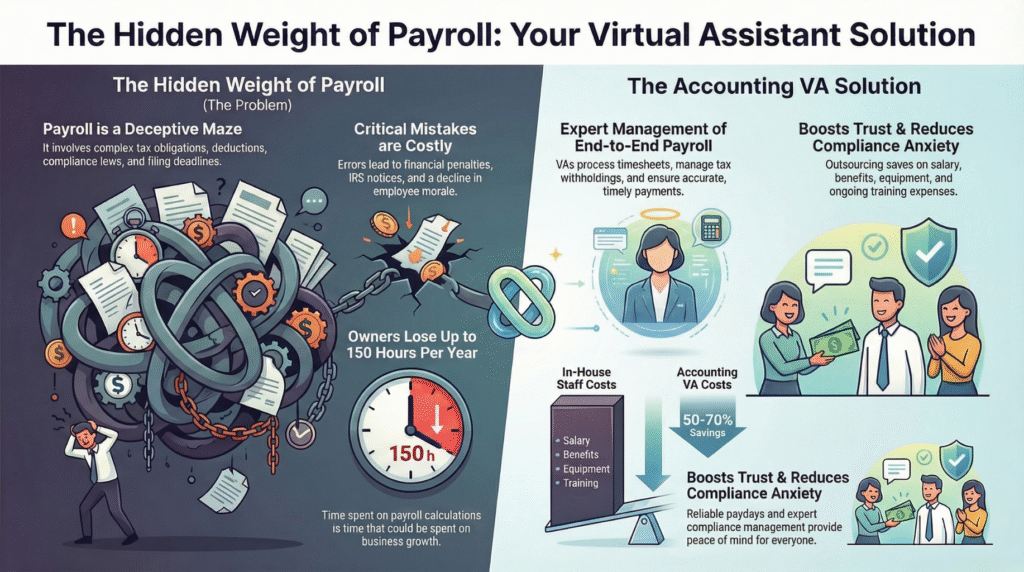
Let’s be honest for a second. Payroll looks deceptively simple from the outside.
People work → people get paid.
That’s the fictional version.
In reality, payroll is a maze of:
Payroll mistakes can get expensive. Not just financially — emotionally. Employees feeling undervalued or frustrated because their paycheck is wrong? That’s a culture killer.
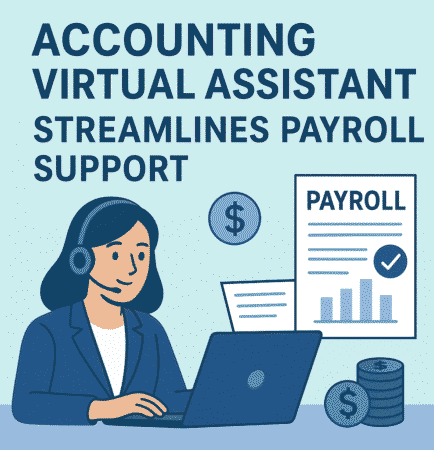
This is why more companies — from solopreneurs to mid-sized teams — are turning toward an accounting virtual assistant specializing in payroll support. Because the job requires precision, and precision requires focus.
Most people imagine virtual assistants scheduling emails or doing simple admin tasks. But payroll-focused accounting VAs operate on a completely different tier.
They’re the behind-the-scenes powerhouse keeping your payroll engine humming.
This includes:
It’s not “data entry.” It’s orchestrating a workflow that must run perfectly every single time.
Tax rules change more than most people’s morning routines.
An accounting virtual assistant stays on top of:
They ensure accuracy so you don’t accidentally under- or over-deduct — both of which cause headaches no business owner needs.
Your VA becomes the guardian of payday.
They monitor:
And yes, they’re the person who double-checks that everyone gets paid correctly… so you never wake up to a frantic Slack message again.
They organize:
This matters for:
Think of them as your payroll librarian, and your library is always filed perfectly.
Payroll rarely stands alone.
An accounting virtual assistant supports:
They become a connective tissue between departments — smoothing communication, preventing errors, and speeding up transitions.
Now, this part surprises people.
Hiring an in-house payroll admin sounds ideal… until you compare cost, flexibility, and expertise.
In-house payroll specialists typically cost:
An accounting virtual assistant?
Usually 50–70% less — with equal or greater skill.
Payroll isn’t one-size-fits-all. It evolves:
An outsourced professional already knows the systems, pitfalls, and compliance rules. You aren’t paying to “train them up.”
In-house payroll person calls in sick? Takes PTO? Quits?
Your business stalls.
A payroll-focused virtual assistant firm often has:
Meaning payroll still runs — even when life happens.
Five employees.
Fifteen employees.
Fifty.
Your VA adapts without forcing you to hire or restructure.
Here’s where things get real.
Hiring an accounting virtual assistant to handle payroll support creates noticeable shifts inside your business:
If you’ve ever delayed payroll until the evening because everything else felt urgent — this is your moment of relief.
Owners report saving:
That’s time you can redirect into growth instead of calculations.
Nothing tells employees “we care” like:
People remember bad paydays.
They also remember reliable ones.
A payroll mistake can trigger:
Your VA acts like your safety net, keeping everything aligned with the latest rules.
Accurate payroll → accurate reporting.
Knowing your true labor costs helps with:
It’s the foundation of healthier financial decisions.
A boutique ecommerce brand with 14 employees reached out because payroll kept slipping through the cracks. Team members were paid on different schedules. Overtime calculations were off. A tax deduction error resulted in a notice they didn’t know how to interpret.
Morale was dropping.
Within six weeks of hiring an accounting virtual assistant:
The tax issue?
Handled, corrected, documented.
The founder said it felt like “the business finally exhaled.”
This is where founders either succeed or struggle. Not all VAs are payroll-capable.
Look for:
✔ Payroll system proficiency (Gusto, ADP, QuickBooks, Rippling, Paychex)
✔ Experience with payroll compliance
✔ Understanding of multi-state tax rules (if applicable)
✔ Knowledge of employee classifications (W-2, 1099, contractors, exempt/non-exempt)
✔ Absolute precision and attention to detail
✔ Strong judgment around confidentiality
✔ Clean communication style
✔ Ability to work proactively, not reactively
If a VA hesitates or is vague about payroll experience — keep searching.
Here’s a quick breakdown of the workflow many elite payroll assistants use behind the scenes:
They gather or verify:
They analyze:
They run payroll using standardized procedures to avoid slip-ups.
This includes double-checking:
Everything gets filed neatly for:
This is the stuff that keeps your business clean, clear, and confident.
They manage end-to-end payroll tasks — processing payroll, updating tax deductions, managing benefits adjustments, and ensuring accurate and timely salary payments.
Yes. Reputable accounting VAs follow strict confidentiality protocols, NDAs, secure storage systems, and compliance workflows.
Rates range from $20–$60/hour depending on experience and complexity, with monthly packages available.
Many can. Just verify their experience with multi-state wage laws or international payroll platforms.
Common tools include Gusto, QuickBooks Payroll, ADP, Paychex, Rippling, and BambooHR.
Often within days — sometimes within hours — depending on the error and needed documentation.
Absolutely. In fact, small businesses often benefit the most because payroll consumes a larger percentage of their operational time.